Openers · Toronto
Belt-Drive Opener Repair
It is minus twenty in the detached garage and the door climbs in jerks, the belt stiff as a board. By the afternoon, when the sun has been on the door, it runs almost normally again.
Belt-Drive Opener Repair
In plain words
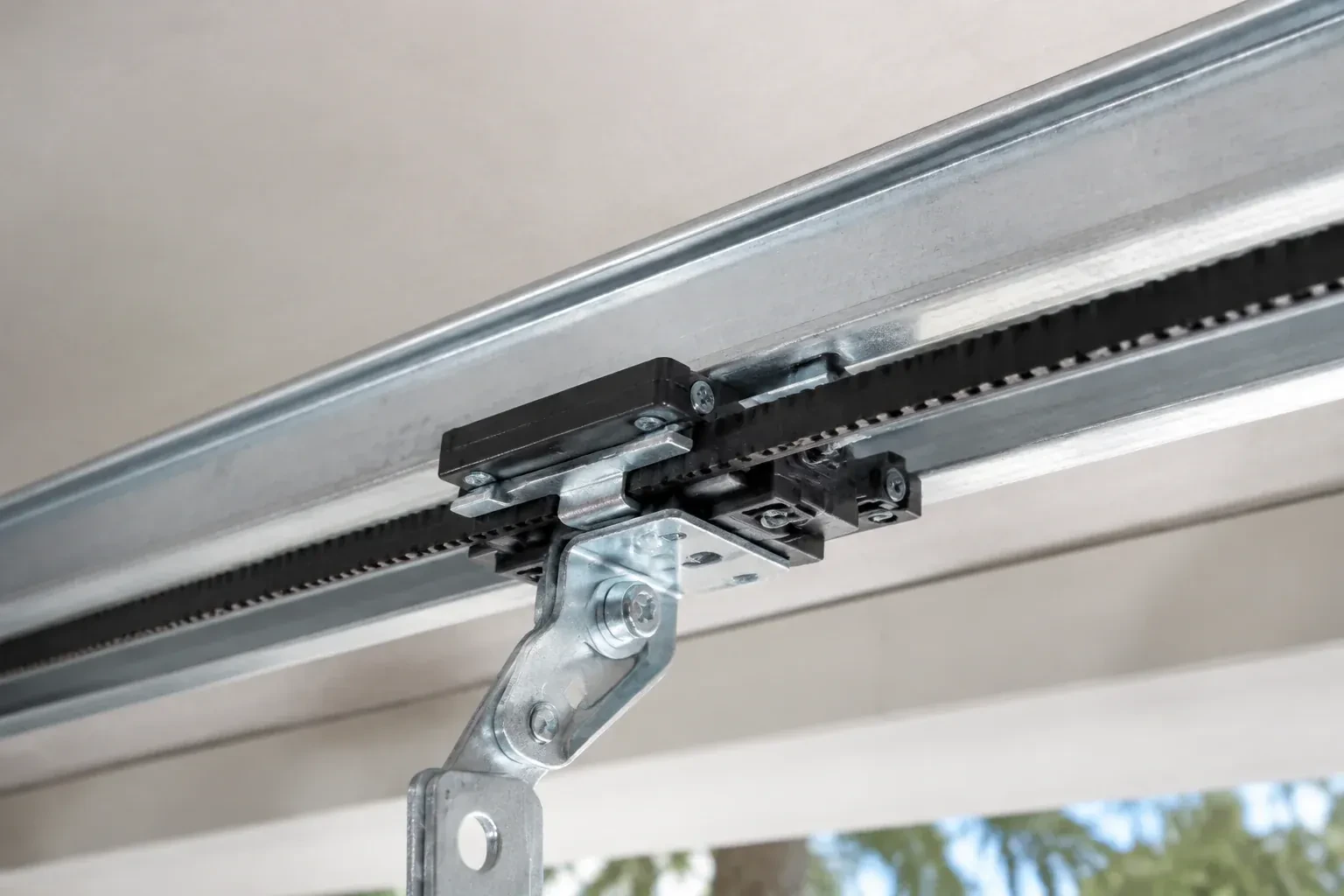
Belt-drive operators use a toothed belt reinforced with steel or fibre cords, and those belts wear in recognisable ways. Age and temperature swings make the rubber brittle, so it cracks across the back and eventually shows the cords. Rubbing on a bent rail or a misaligned joint frays one edge. A door that hits something can shear a stretch of teeth or throw the belt off the idler pulley. A small clip joins the belt to the trolley and takes every start and stop. Repair fits a belt of the right length and tooth pitch for that rail, a fresh clip, and sets the tension from scratch.
How the visit goesThere is a new squeal from the front of the rail, up near the header, on every cycle. The belt has started tracking to one side and its edge is fuzzy where it has been rubbing.
Toronto
How the visit goes
Sprocket, pulley and the shavings that give them away
The belt runs over two wheels: a drive sprocket on top of the motor head and an idler pulley at the far end of the rail. The technician looks at the sprocket's teeth for hooking and wear, feels for wobble on its shaft, and checks the housing below it for the plastic shavings that mean the drive gear inside is stripping. At the front, the idler pulley is spun by hand for roughness or a dry bearing and sighted along the rail to see whether it is letting the belt track off to one side. A worn sprocket chews a new belt within months, so this check decides whether the gear-and-sprocket kit belongs in the repair.
Putting motor and trolley back in step
Any time the belt has been off the sprocket, the operator's sense of where the door is can drift from where the trolley actually sits, so this step is done before the door is reconnected. The technician lifts the belt clear of the sprocket, runs the operator until the sprocket turns to its closed position and stops on its own, then slides the trolley to the closed end of the rail and refits the belt. Motor and trolley now agree. On operators with a mechanical limit assembly, the middle contact is adjusted instead. Without this step, the door stops short at one end no matter how the travel limits are turned.
The two tests you do each month
The repair ends with the reversal tests run in front of you, and they are yours to repeat monthly. With the door fully open, lay a scrap of 2x4 flat on the floor where the door meets it, press the wall control and watch: the door should touch the wood and climb back to the top. Then, with the door closing, pass a broom handle through the beam near the floor; it should reverse the same way. Both take under a minute. If either test ever fails, stop using the operator, work the door by the red cord, and have a trained technician check it; the fault can be the settings, the sensors, the wiring or the opener itself.
Belt-Drive Opener Repair
In the van
- Rail joint brackets and stop bolts
- Inner and outer trolley
- 2x4 offcut for the reversal test
- Rail hanger straps and fasteners
- Reinforced drive belt with clip
What affects the quote
Same fees day, night or weekend
1A second operator on the same property
Where a double garage has two belt drives, or a workshop has its own, both can be looked at in one trip, and the quote shows the two repairs on a single visit.
2Gear and sprocket kit
Shavings on the motor head mean the drive gear is stripping. Replacing the gear-and-sprocket set means opening the head unit, which is more time and a more substantial part than belt work alone.
3Trolley condition
A trolley that releases and re-engages cleanly stays. One that is cracked, stuck or loose on the rail is replaced during the same visit and listed as its own part.
Belt-Drive Opener Repair: questions
Can the belt just be tightened, or does it need replacing?
Tightening is the first thing tried. Tension is set at the inner trolley by a square nut that compresses a spring to the length the maker specifies. If the belt reaches that setting and runs without sprocket noise, it stays. If the adjuster is wound to its end and the belt still sags, or the rubber is cracked, glazed or missing teeth, a new belt is the right repair.
Can I adjust the belt tension myself?
The adjustment nut is reachable and some owners do, but there are two things to get right. The operator must be unplugged and the door released first, and the spring must be set to the maker's length rather than tightened until the sag disappears, since an over-tight belt is noisy and hard on the motor. After any change, the reversal tests should be repeated. Many people prefer to have it done during a service.
Does the trolley need replacing when the belt does?
Not usually. The trolley is checked while the belt is off: its halves should part with the release cord and lock again, the housing should be free of cracks and it should ride the rail without play. A trolley that passes those checks stays and simply receives the new belt and a fresh clip. One that sticks or rattles is replaced in the same visit.
Openers & Access
- Chain-Drive Opener RepairThe door closes, touches the floor, then climbs straight back up as if it hit something.
- Garage Door Opener ReplacementYou swapped the old wooden door for a heavier insulated steel one, and the twenty-year-old opener…
- Photo-Eye Sensor Alignment or ReplacementAfter a cold night the door stays open until the garage warms up.
Belt-Drive Opener Repair near you
Shops, warehouses and service bays in Toronto have their own list: rolling steel doors, heavy sectional doors, industrial operators, safety edges and high-cycle springs. Alongside our residential work, we service and replace all of these and can set up a maintenance schedule that fits your operating hours.